
Introduction: The Urgency of Digital Transformation in 2026
In 2026, digital transformation is no longer a strategic initiative discussed in boardrooms - it has become a defining factor between companies that grow and those that gradually lose relevance.
Over the past few years, enterprises have faced a convergence of pressures: global economic uncertainty, rapidly evolving customer expectations, and the acceleration of technologies like AI, cloud computing, and automation. These forces are not operating in isolation - they are compounding each other, creating an environment where speed and adaptability are critical.
Customers today expect seamless digital experiences across every touchpoint. Employees demand flexible, tech-enabled workplaces. Meanwhile, competitors, who are often smaller, more agile, and digitally native - are entering markets with lower costs and faster innovation cycles.
In this context, digital transformation is no longer a “nice-to-have” initiative. It is a core business strategy that directly impacts revenue growth, operational resilience, and long-term competitiveness.
The question is no longer “Should we transform?”
It is “How fast - and how effectively - can we do it?”
What is Digital Transformation?
At its simplest, digital transformation refers to the integration of digital technologies into all areas of a business.
However, this definition alone does not fully capture its impact.
Many organizations mistakenly approach digital transformation as a technology upgrade—implementing new software, migrating to the cloud, or adopting AI tools. While these are important components, they are not the transformation itself.
True digital transformation is about reimagining how a business operates and delivers value.
It involves 3 fundamental shifts:
1. From process-driven to customer-centric
Organizations move away from rigid internal processes and redesign workflows around customer needs and experiences.
2. From intuition-based to data-driven decisions
Leaders no longer rely solely on experience or assumptions - they leverage real-time data and predictive analytics to guide strategy.
3. From static operations to continuous innovation
Instead of periodic upgrades, businesses adopt an agile mindset, continuously testing, learning, and improving.
This is why digital transformation is not a one-time project - it is an ongoing evolution.
👉 To dive deeper, you can understand the core of digital business transformation and how CEOs lead this shift.
Key Drivers and Benefits: Why Make the Shift Now?
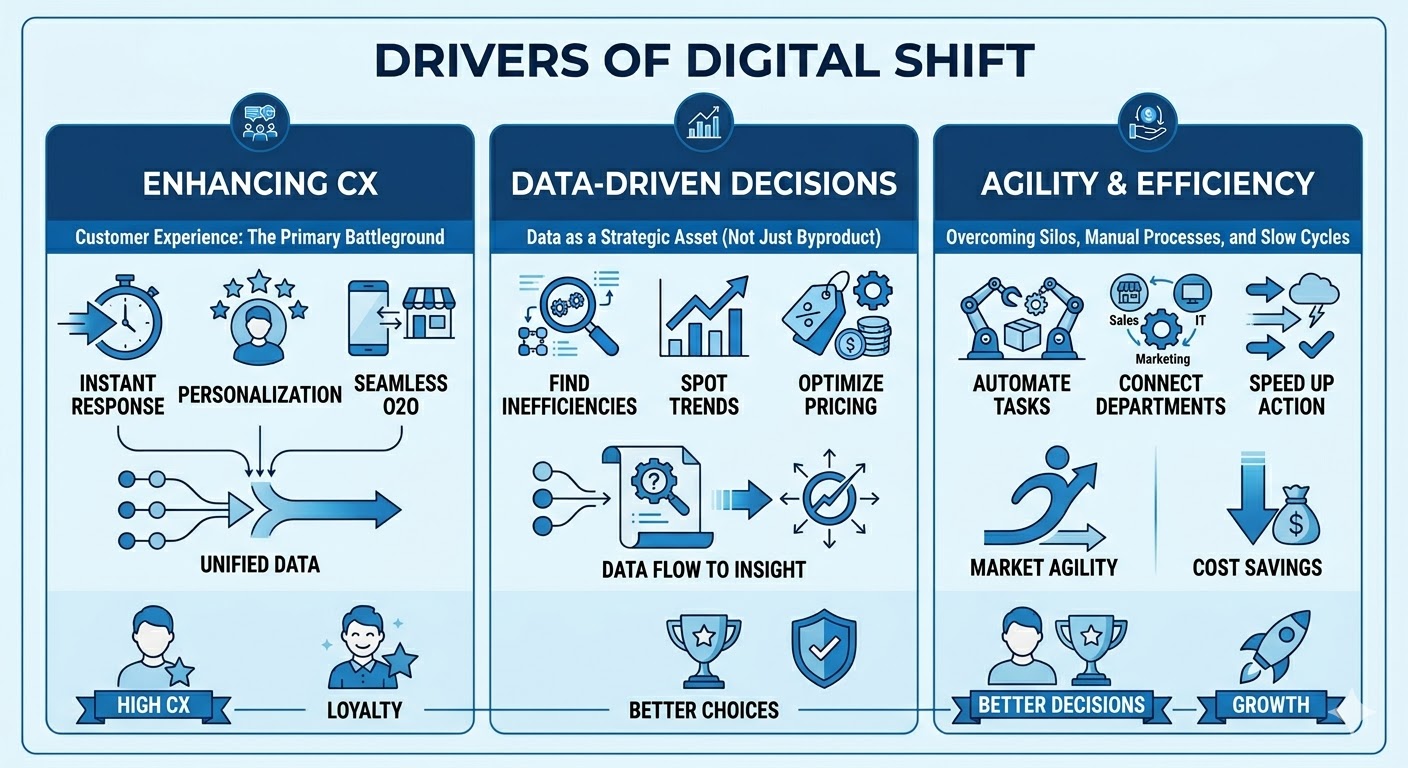
Enhancing Customer Experience (CX)
Customer experience has become the primary battleground for competition.
In 2026, customers expect:
- Instant responses
- Personalized recommendations
- Seamless transitions between online and offline channels
Digital transformation enables organizations to meet these expectations by unifying customer data, automating interactions, and delivering consistent experiences across platforms.
More importantly, it allows businesses to move from reactive service to proactive engagement—anticipating customer needs before they are explicitly expressed.
Data-Driven Decision Making
Data is no longer just a by product of operations—it is a strategic asset.
Enterprises that successfully leverage data can:
- Identify hidden inefficiencies
- Predict market trends
- Optimize pricing and operations
For example, instead of reacting to declining sales, a data-driven organization can detect early signals and adjust strategy in real time.
This shift significantly reduces risk and improves decision quality at every level of the organization.
Operational Agility and Cost Reduction
Traditional business models often struggle with inefficiencies—manual processes, siloed systems, and slow decision cycles.
Digital transformation addresses these challenges by:
- Automating repetitive tasks
- Integrating systems across departments
- Enabling faster communication and execution
The result is not just cost reduction, but organizational agility—the ability to respond quickly to changes in the market.
The Core Technologies Powering Digital Transformation
Behind every successful digital transformation strategy lies a carefully selected technology stack. However, the goal is not to adopt every new technology, but to choose the right combination that aligns with business objectives.
Cloud Infrastructure: The Foundation of Scale
Cloud computing is often the first step in digital transformation - and for good reason.
It replaces rigid, on-premise systems with flexible, scalable infrastructure that can grow with the business.
Instead of investing heavily in physical servers and maintenance, companies can:
- Scale resources on demand
- Reduce downtime risks
- Accelerate product deployment
More importantly, cloud platforms enable faster experimentation, allowing businesses to innovate without being constrained by infrastructure limitations.
👉 Explore TechTack’s Cloud solutions.
AI & Machine Learning: From Automation to Prediction
Artificial intelligence has evolved far beyond basic automation.
Today, AI enables organizations to:
- Predict customer behavior
- Optimize supply chains
- Detect anomalies and risks in real time
The true value of AI lies in its ability to transform data into actionable insights—helping businesses move from reactive operations to predictive strategies.
👉 Discover TechTack’s AI & ML services.
Cybersecurity in a Boundaryless World
As businesses become more digital, they also become more vulnerable.
Data breaches, cyberattacks, and compliance risks are no longer isolated incidents—they are ongoing threats.
Modern cybersecurity is not just about defense. It is about building trust.
Organizations must ensure:
- Data integrity
- System resilience
- Continuous monitoring and threat detection
Without a strong cybersecurity foundation, digital transformation efforts can quickly become liabilities.
👉 Learn more about TechTack’s cybersecurity solutions.
Custom Software Development
No two enterprises are exactly alike—and neither are their operational needs.
Off-the-shelf solutions often fall short when it comes to flexibility and scalability.
Custom software development allows businesses to:
- Build systems tailored to their workflows
- Integrate seamlessly with existing infrastructure
- Create unique competitive advantages
In many cases, custom solutions become the backbone of a company’s digital ecosystem.
👉 See TechTack’s software development services.
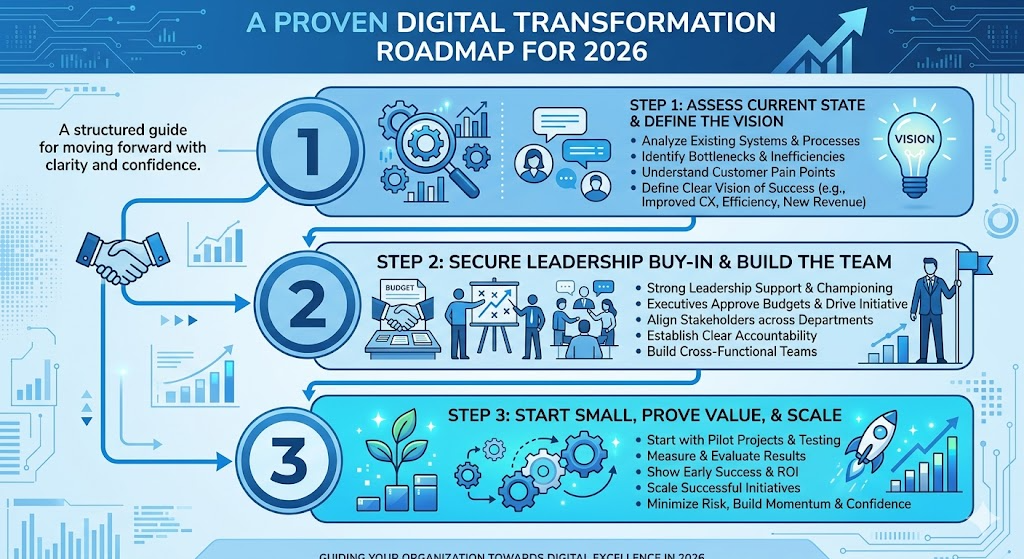
A Proven Digital Transformation Roadmap for 2026
Digital transformation is complex, but it does not have to be chaotic. A structured roadmap helps organizations move forward with clarity and confidence.
Step 1: Assess Current State and Define the Vision
Every transformation begins with understanding where you stand.
This involves:
- Evaluating existing systems and processes
- Identifying bottlenecks and inefficiencies
- Understanding customer pain points
From there, organizations must define a clear vision of what they want to achieve—whether it’s improving customer experience, increasing efficiency, or unlocking new revenue streams.
Without a clear vision, transformation efforts often become fragmented and ineffective.
Step 2: Secure Leadership Buy-in and Build the Team
Digital transformation cannot succeed without strong leadership support.
Executives must not only approve budgets but actively champion the initiative.
This includes:
- Aligning stakeholders across departments
- Establishing clear accountability
- Building cross-functional teams
👉 You can learn about the critical role of a chief digital transformation officer in driving these initiatives.
Step 3: Start Small, Prove Value, and Scale
One of the biggest mistakes organizations make is trying to transform everything at once.
A more effective approach is to:
- Start with pilot projects
- Measure results
- Scale successful initiatives
This approach minimizes risk while building internal confidence and momentum.
Common Pitfalls and How to Overcome Them
Despite its importance, many digital transformation initiatives fail—not because of technology, but because of people, processes, and strategy.
Resistance to Change
Employees often resist change due to uncertainty or fear of disruption.
How to overcome it:
- Communicate clearly and consistently
- Provide training and support
- Involve employees early in the process
Legacy Systems
Outdated systems can slow down or even block transformation efforts.
How to overcome it:
- Modernize gradually instead of replacing everything at once
- Use integration layers (APIs, middleware)
Choosing the Wrong Partner
Technology alone does not guarantee success. Execution matters.
How to overcome it:
- Choose partners with proven experience
- Focus on long-term collaboration, not just cost
Conclusion: Partnering with TechTack for Your Digital Journey
Digital transformation is not a destination - it is a continuous journey of adaptation and growth.
For enterprises, the challenge is not just adopting technology, but aligning it with strategy, people, and processes.
At TechTack, we help organizations navigate this complexity by combining strategic thinking with technical expertise. From defining transformation roadmaps to implementing scalable solutions, we partner with businesses at every stage of their journey.
You don’t have to navigate digital transformation alone.
👉 Start today:
- Book a Free Consultation
- Or request a Tech Audit to evaluate your current systems
Because in 2026, the companies that succeed are not just the ones that transform - but the ones that transform effectively.

